The REACH Regulation n ° 1907/2006 requires all companies that manufacture or import a substance on the EU market in quantities exceeding 1 ton/year to register this substance to the European Chemicals Agency (ECHA).
For legal reasons, only companies with a legal entity in Europe are authorized to submit a registration.
Registration means submitting a dossier to ECHA (European Chemicals Agency). This dossier must contain information regarding the physical / chemical, toxicological and ecotoxicological properties of the substances. Based on the tonnage band of the substance produced / imported each year (1-10 tonnes, 10-100 tonnes, 100-1000 tonnes,> 1000 tonnes) and the hazard classification, REACH provides for different levels of information and data concerning the substance.
It is also mandatory to provide a chemical safety assessment (CSA / CSR) when the substance is hazardous according to the criteria of CLP Regulation n. 1278/2008. Every identified use, along the entire supply chain must be evaluated.
Companies located outside the EU are not allowed to submit REACH registration dossiers for chemicals to ECHA, however according to art. 8 of REACH may appoint an Only Representative established in Europe to assume the tasks and responsibilities of importers in order to ensure compliance with the REACH Regulation.
CEPRA is able to provide a FULL SERVICE for REACH Registration.
Our main services
- SAMENESS ANALYSIS
- REGISTRATION STARTEGY
- DATA GAP ANALYSIS
- INQUIRY AND REGISTRATION DOSSIER (individual and joint submission)
- TESTING & QSAR
- ONLY REPRESENTATIVE
REGISTRATION KEY POINTS
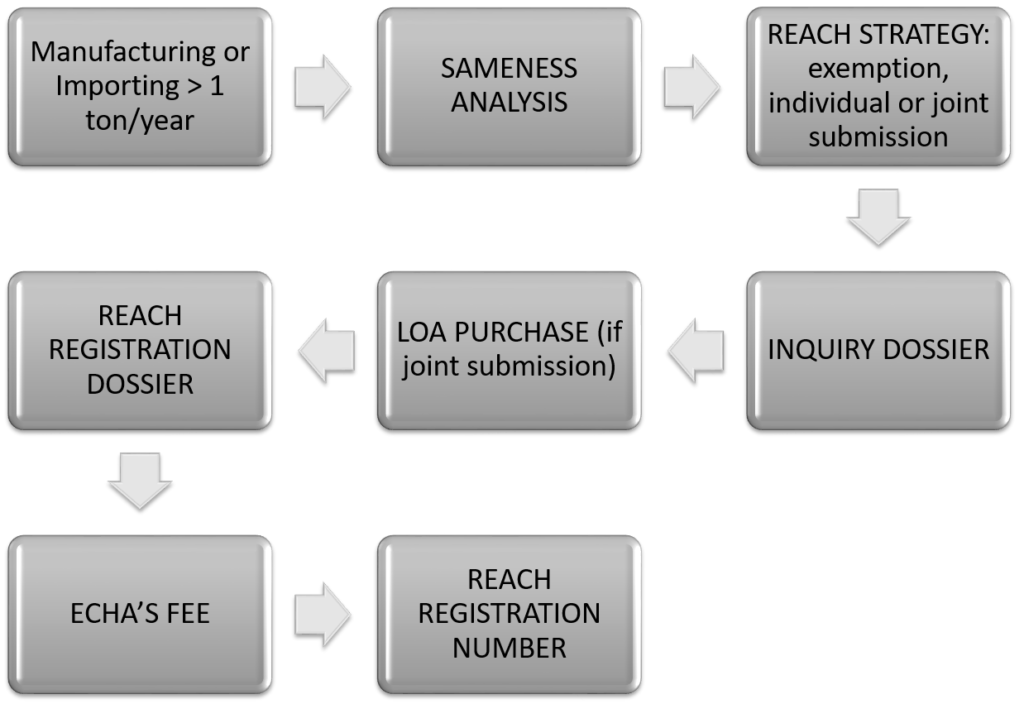
- STEP 1 – IDENTIFY YOUR SUBSTANCE
- STEP 2 – CHECK IF ANY EXEMPTION IS APPLICABLE
- STEP 3 – REGISTRATION STRATEGY
- STEP 4 – SUBMIT INQUIRY DOSSIER
- STEP 5 – SUBMIT REGISTRATION DOSSIER
INQUIRY DOSSIER
The registration process begins with the submission of an inquiry dossier.
An inquiry is the process by which a potential registrant asks ECHA whether a valid registration has already been submitted for the same substance. The purpose of the inquiry is to facilitate data sharing among companies registering the same substance.
The Inquiry dossier must be submitted before manufacturing or importing a substance in quantities exceeding 1 metric ton per year (unless any exemptions from registration apply).
REGISTRATION DOSSIER
The registration dossier to be submitted to ECHA consists primarily of two elements:
- a technical dossier, which is always required for all substances subject to registration requirements;
- a CSR (Chemical Safety Report), which is required if the registrant manufactures or imports a substance in quantities of 10 metric tons or more per year.
Technical Dossier
Manufacturers and importers must compile all available information on the intrinsic properties of a substance, as well as on its manufacture, uses, and exposure.
The technical dossier contains information on:
- the identity of the substance
- Information on the manufacture and use of the substance
- The classification and labeling of the substance
- Guidance on safe use
- (Robust) study summaries of information on intrinsic properties
- Proposals for further testing, if relevant
- For substances registered in quantities between one and ten metric tons, the technical dossier also contains information on exposure to the substance (main categories of use, types of use, significant routes of exposure)
Information on chemical-physical, toxicological, and ecotoxicological properties varies depending on the tonnage band for which registration is sought:
1–10 metric tons/year – Annex VII of REACH
10–100 metric tons/year – Annex VIII of REACH
100–1,000 metric tons/year – Annex IX of REACH
≥1,000 metric tons/year – Annex X of REACH
EXEMPTIONS
- Polymers: substances meeting the definition of a polymer under REACH do not need to be registered, but the monomers and other substances used for the manufacture of the polymer may need to be registered.
- Substances covered by Annex V to REACH: this list describes 13 broad categories of substances.
- Substances included in Annex IV to REACH: this list contains 68 low-risk substances, typically of natural origin, including water.
- Radioactive substances: substances giving off such radiation that humans and the environment need to be protected are regulated by the Euratom Directive.
- Substances covered by a national exemption in the interest of defence.
- Re-imported substances already registered.
- Recovered substances already registered.
The following substances do not need to be registered when only for specifci uses.
- Non-isolated intermediates: intermediates that during the synthesis are not intentionally removed from the equipment in which the synthesis takes place (except for sampling).
- Substances used for product and process orientated research and development (PPORD): these substances are exempt from registration for five years (extensions possible), if you notify your PPORD activities to ECHA.
- Substances used in food or feeding stuffs (including uses as additives or flavourings).
- Substances (active substances or excipients) used in medicinal products for human or veterinary use.
- Active substances used in biocidal products or plant protection products. These are regarded as already registered.
DOSSIER UPDATE
There are two types of updates for the registration dossier: requested and spontaneous
You must update the dossier when new data on the substance becomes available, such as:
- data on composition / change of supplier / change of process
- on its properties
- the field of use
- risk management measures
- changes in the volume produced/imported
- specific ECHA requests following evaluation
Regulation 2020/1435 provides registrants with guidance on the timing of registration dossier updates.
EU REACH MAIN COSTS
- Administrative Fees
| Paid to the European Chemicals Agency (ECHA) for REACH registration and related regulatory procedures
Key Factors Influencing Administrative Fees
|
* the Regulation (EU) 2025/2067 introduces a prior verification process that eliminates the option of self-certification at the time of dossier submission. Key points to note include:
- The request for SME status recognition must be submitted to ECHA at least two months before the planned dossier submission.
- ECHA will review the documentation and issue an official decision within two months of receiving the request.
- Reduced SME fees cannot be applied under any circumstances without prior formal recognition of the status.
- Once SME status has been recognized by ECHA, the recognition decision remains valid for three years.
- Data Fees
| Paid to the Lead Registrant (LR) or data owners for access to existing data
Key Factors Influencing Data Fees
|
- Testing Fees
| Paid to laboratories to generate required data and fill data gaps |
- Service Fees
| Paid to an Only Representative (OR) or consultancy for compliance support and registration services |